
RTA Lectores are told about Polish and Latgalians
“Like a lattice, then Poļac, Tod chyghōne.” What is it? ”– such a bright puzzle will be only one of the facts that will remain in mind from the meeting with the Rēzekne Technology Academy (RTA) lecturers, whose Maltese were introduced by Paul and the Latgalian joint and different.
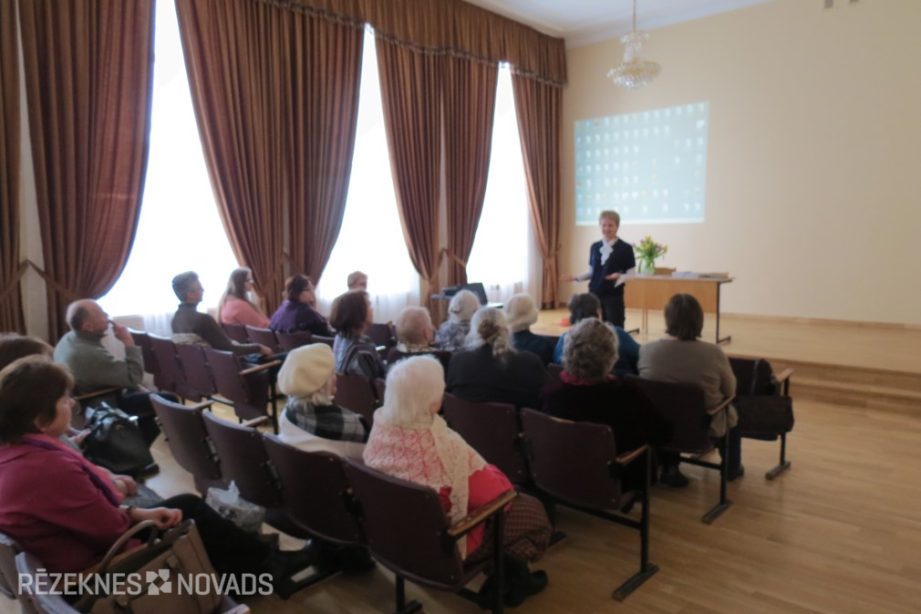
On 9 March, Maltese had an opportunity to participate in the seminar “Polish cultural influence in Latgalian folklore” organised by THE History Museum OF Maltas and to meet with the Rēzekne Technology Academy's studies and science prorectors, the doctors of philology, the associate professor Angelika Jusko-Schtekel and the Philology Doctor Antru Kļavinsk. This meeting was organised by the museum manager Sylvia Pigožne, who spoke to Mrs. Angelika in the opening of the exhibition museum OF Viļānu.
First OF all, MR Jusko-Schtekele, in his speech, said that “researchers have what to do thanks to tradition, culture, such as THE Maltas museum, as a Polish society”, and expressed the pleasure that many of her students, including lecturer Antra Kļavinska, have been educated and actively engaged in a variety of important sectors. Similarly, Mr Jusko-Schtekele gave a warm welcome to Sylvia Peager from THE RTA rector Edmund Turumer, who had ever had a classroom.
The presentation was first offered by Antra Kļavinska, stating that she was more of a linguist who is studying ethnicity – the names of different nationalities: “ethnic composition in Latgale is very raged, but the Polish today is the third largest ethnic minority. It is also important that in the first Population census in 1897, when the Latvians had no consciousness, what and what the nationality was mentioned in“ Catholic ”. But in the Latgalian folklore, the Roma and Jews are most mentioned, as the attention is paid to what is different. She also told him that the Latgalians had called“ hobbies ”and“ poles ”, the folklore texts being“ Polish and Polish ”and often cited as desirable marriages. This designation is also in local words, for example, in the municipality of Ciblas, Pusmucova parish, there are local names Laki, Poļaki, and IN THE Kaunatas side of the Polish-known storm (the word“ star ”appears only in 19.gs. On side 1), but in Polish it is called“ bocian ”. In contrast, the vivids in Latgalian – Polish Inflanty peasants) have been called poles. Similarly, the lecturer had also found one example from Maltas –“ Maltese pub Suņs nūde jydam vysti ”.
Angelika Jusko-Schtekele, in his presentation, turned to the views of Polish scientists on the Latgalians. She was really interested in reading the last year with the support of the State Culture Capital Foundation, Viļānu Municipality and RTA, the final ethnographic image of the 19 th century “Polish Inflanty Latvians” (one part of three), which contains unique evidence of THE population of Viļānu, traditions, beliefs, etc. 19 th century. On the 2 nd side, in addition to “such a beautiful Latgale voluminous voluminous wolf, the passion is going to be a lovely house, how beautiful, a crowd that Latgale Bay will be nailed for a long time”! Every man had a chance to get both this and other RTA books and prizes in his possession. (In this respect, Mrs Clara was the most active and most knowledgeable, who also knew that the Poles had always liked the puppy and had been said “by the polish of the pole”, and the Polish-like bright colours.)
But it was interesting to find out in the vicinity of the Viļānu spotted by S.Ulyjanovsk: Latgalians (which Uļjanovsky called “Nashi latyi”) had not been a fruit garden at the time, they also eaten the meadows of the meadows (bubbles), the wives embroidered during the service of the villaine, the highest salary had been the parish of the parish; there was also a mask “butter-nicker, a meal of flour” in the middle of the traditional masses; people believed that by stripping the 3 moles in one hand in such a way as to prevent the failure of the blood, the man would gain supernatural powers, but if he could not remain, then drink water drained from the mouth of the white stallion, etc. It was also mentioned, for example, the language misunderstandings – “Muna dusņka”, “Myziga aneišona” – Latgalians are bound by the word “duchit” – strangled The lecturer also mentioned an expedition in Indra, at the border of Belarus, where people said “nasenskaya voloda” (Latvian, Belarusian, Russian, Polish word mix). In fact, a lot of information was offered – from smiling to surprise and thinking! Both Latvia and Poland are looking for the place of s.uļjanovsk, and this year, an expedition to a monastery in Poland is planned with such a goal.
Similarly, Mr Jusko-Schtekele mentioned a second researcher Vladislava Veriho, who took the folklore in Ludza's surroundings and wrote 32 fairy tales in the book “Podania łotewskie” (1892), but there are many non-typical motives of Latgalian folklore (for example: Gvida, Lada, Kasmach, Zyberts; a two-storey house with balcony and parade ladder, etc., which was certainly not the ikdiena of Latgale). The exciting narrative of A.o.-Schtekel, based on the interest of the comprehensive scientist, could also be heard after the lecture, enjoying a wonderful peppermint tea (thanks to the Polish association with Mrs Clara Kondrova at the front!). The scientist also confessed that he had a particular connection with the Holy John Paul II, and the Jadviga of Okuņevich did not only show all his pictures, but also made a memorial gift. Lectores also expressed regret that she had not known about it before, but she promised to go to the village and learn to speak politically.
I have to admit that the hall in the building on the streets of Freedom 6, in Malta, has become very cosy (perhaps here every week on the Wednesday service is influenced by and with the help of the Polish society!), but this is the time that i would like to remind you that it is not just the old building of the music school, but also my first school, in which i began to learn as a pre-graceful. For that reason, it was particularly emotional to see her high school teachers, Mrs Angelika, who had once been motivated by her exam to do all the living – to do everything “for more than 6 parties”...
But this can only be achieved through the opportunities offered by life, which many often miss. Unfortunately. There are so many intelligent people in Malta who can inspire co-workers and young people with their own example. If we do n't do it, God, go back to a level that is once seen in Latgale by S.Uļjanovsky: “there are people and lands like a curse.” No one is interested in them, nothing is known about it … '. But at that time, and now villages, the cities themselves make up their image. Despite the unpleasant statistics mentioned by A.Jusko-Schtekele, the birth rate was once born in Latgale from 13 children in the family to one day (among others, in 1937 in Malta, there were 9913 inhabitants). Currently, not globally or locally, there is no way out. The tragedy will be if we don't change our attitude... Then we're going to be something again, just not the “Polish Inflantes Latvians”, but the people who are currently eight children in the family. Not in vain: “protect yourself and God will protect you”... In place of the word “guardian”, many acts have been mentioned today, but the most important of them – think and act!
***
P.S., but at the beginning of the article, the mention of the dough is the following: “scalp, fire and charcoal.” 'Well, isn't it?' Latvians – cracking, Polish – temperament, gypsies – look.
Skaidrite Swicksha
