
New Rēzekne municipality border signs will be improved
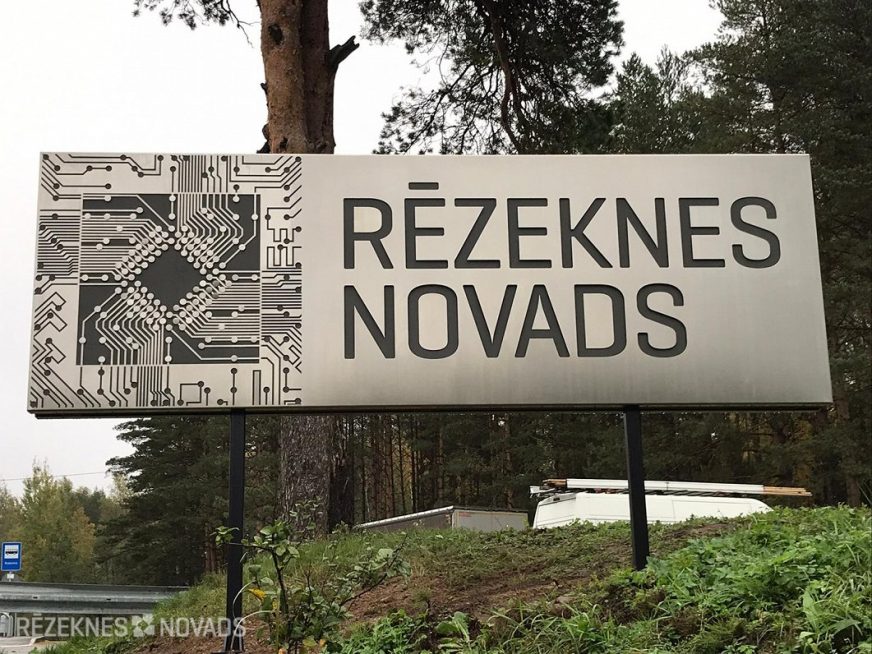
In mid-October 2020, on the highway A 13 in Rusenica and Vonogow, and on highway A 12 Stolbovka, in the direction of Ludza, the new Rēzekne border signs were installed, replacing the old concrete posts that had been installed more than 30 years ago.
The new boundary marks include the logo ornament of the Rēzekne municipality – an article from the points and lines that are the combination of the ethnographic solar sign and the stylisation of the computer's mother plate, and which at the same time reminds the municipality of a map of the municipality – graphic grubbing fields, river and road network lines surrounded by populated areas. The logo in the Rēzekne municipality is printed in publicity material, prints, presentations are used since 2017.
The border marking project was produced by the Metal Project. Architect Didzis Jaunlow explained in an interview “Latvian Radio”: “This two-dimensional idea developed by the artist of Rezekne, Daina's straw, is simply transformed into a three-dimensional object. The idea was that the article that was created in view of both the Latvian motives and contemporary performances, we also wanted to include the Rēzekne municipality in the border. We chose two materials: cement plates and stainless steel, so that one material is more rough and the other is more contemporary, related to technology, like the parent plate chosen by the artist as one of the identity guides. Laser articles in stainless steel. Another idea why we chose stainless steel is to change the marks. Stainless steel partly reflects the surrounding area. This means that in the summer, when the green trees are around, the threshold will have a different colour than in a snowy winter.”
After hearing the views of citizens and drivers following the installation of border marks, it was found that, although the border mark itself was original, it was too integrated into the surrounding environment when it merged with it. Drivers indicate that the new border signs are difficult to see especially during the dark day. Consequently, designers were given the task of developing a solution whereby border signs would be made more visible at any time of the day. At the beginning of November, D. New Low explained: “currently the signs are already installed, but the specific turn (angle of location) against the road and the colours of the rear cement plates is still tested. It's still in the process. It is now the idea that the decorated parts of the mark might be painted in reflective colour, so that the mark is better seen in the darkness of the day. '
At this time, we can report that the designers have set up an acceptable solution with the local government and once the weather conditions have been applied, the established border signs will be improved in the light of the recommendations received.
Iveta grain
Rezekne municipality council
pr Officers p.i.