
Holy Trinity Roman Catholic Church in Puša
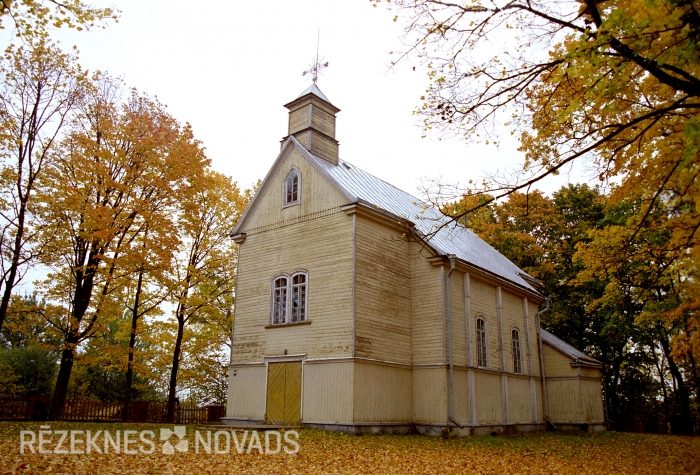

The church was built in honor of the Holy Trinity. The church was built by the Polish nobleman Jānis (Jans) Antons (Antonijs) Šadurskis at his own expense. It was consecrated in 1778. The building was built according to the building construction methods of the time, log construction - the log building was hewn only with an axe.
The church is located on a beautiful hill, surrounded by deciduous trees. There is a fence around it: brick posts on a brick foundation with wooden battens. The entrance gate is made of red bricks. There is a small turret above the church entrance. The roof of the church is made of galvanized sheet metal, the foundation is made of brick, and there are bricked-up basements under the church.
In the churchyard, on the right side, there is a large 19th century bell tower (approximately 10m high) with two bells, one from 1743, the other from 1881, and with a masonry foundation, a carved wooden superstructure and a galvanized tin roof. The tower is an architectural monument of local importance.
The church has three altars. The main altar is dedicated to the Holy Trinity [an altar rich in woodcarvings with a painting from the mid-18th century, 19th century, which is an art monument of national importance], which is why the church is also called the Puša Holy Trinity Catholic Church. The current main altar painting was donated to the church by a member of the Kāpostiņi family. Unfortunately, its author is unknown.
On the right side of the church is the altar of St. Francis de Geronimo (Džironimo). On the left side of the church is the altar of the Holy Mother of God, in the center of which is a statue of Our Lady of Lourdes. Both altars were made in the mid-18th century. The church has a feretron (mid-19th century), a painting of the Holy Trinity (mid-18th century), a monstrance (mid-18th century), and an organ built by the Latvian organ builder Jānis Gremze can be seen. In 1949, dean Ādolfs Tarbunas built a small log building near the church, which is used as a parish rectory. (Cakuls, 1997)
Immediately after construction the church was given to Jesuit in care, who created here Jesuit mission This mission existed the longest: from 1743 to 1820.) At first, only one missionary worked there, but from 1750 there were already two missionaries. When the Russian War Ministry bought back the Jesuit property in Daugavpils, in 1811 all the Jesuits moved to Puša, including the novitiate and the college. From 1811 to 1819, the Dagda Jesuit mission also depended on the Puša Jesuit college. In 1819, the novitiate and college were moved to Izvalta. In 1820, the Jesuits were expelled from Puša, and with it the existence of the mission point in Puša also ended. The Jesuits who died were buried in the basement under the Puša church.
| Address | Puša, Pušas pagasts, Rēzeknes novads |
| Coordinates | 56.2345534; 27.2290676 |
| Phone | +371 64646045, +371 29179427 |